Fats or Lipids: what are they?
Share
By Fats or Lipids we mean a heterogeneous group of organic molecules insoluble in water and soluble in organic solvents with different functions in our body, including:
- Energy : they represent a source of energy that can be used immediately but can also be stored as an energy reserve;
- Structural : they are fundamental constituents of cell membranes and nerve sheaths;
- Regulator : they are precursors of hormones, bile acids, vitamin D and regulate body temperature;
- Transport : they act as carriers of fat-soluble vitamins, thus allowing their absorption.
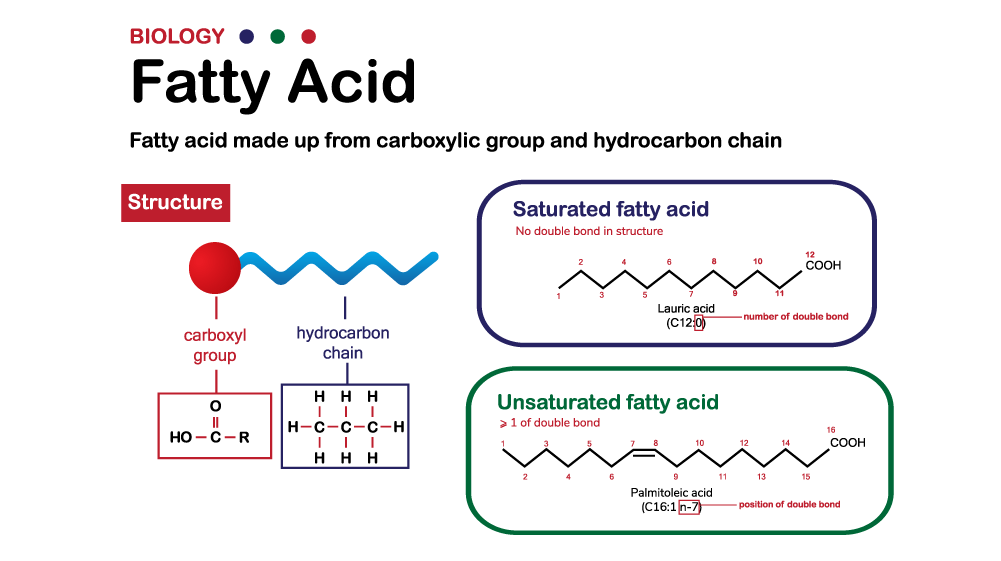
Fatty acids are the main constituents of lipids, they are obtained from the digestion of the lipids themselves and are made up of carbon atoms of various lengths (from 2 to 36) joined together and to hydrogen with a carboxyl group at the end (COOH) which are classified based on the length of the chain and the presence and position of any double bonds; we distinguish:
- Saturated fatty acids (SFA) when the carbon atoms are linked only by simple bonds and therefore no double bonds are present;
- Unsaturated fatty acids when there are residues joined by double bonds in the chain. These are divided into monounsaturated when they have only one double bond or polyunsaturated when there are 2 or more.
Starting from unsaturated fatty acids, trans or hydrogenated fatty acids are obtained through industrial treatments. Excess SFA and trans fatty acids increase some cardiovascular risk factors.
On the contrary, some types of polyunsaturated fatty acids (PUFA) are defined as "essential" as our body is not able to produce them independently and they must therefore be ingested with food. Among these we find linoleic acid belonging to the omega-6 family (presents the first double bond in position 6) and α-linolenic acid belonging to the omega-3 family (first double bond in position 3). From the latter derive two fatty acids, EPA and DHA, whose intake also depends on the diet and represent important elements both for the prevention of cardiovascular diseases and for the correct development and functioning of the central nervous system and the retina.
From a more technical point of view, dietary fats give flavor to foods, contributing to the aroma and therefore to the pleasantness of the food and it is precisely for this reason that there is a tendency to consume them excessively, making them indirectly responsible for the onset of overweight and obesity thus such as diabetes and cardiovascular diseases.
We say indirectly because in reality it is not fats in themselves that are correlated with the onset of these pathologies, but rather an unbalanced diet characterized by an excess of saturated and hydrogenated fats, cholesterol and sugars continued over time.
Another type of fatty substance of great importance is cholesterol, which represents the precursor of numerous hormones, vitamin D and bile salts and is a fundamental component of cell membranes, regulating their fluidity and permeability. Cholesterol can come from both endogenous synthesis and nutrition as it is contained in variable quantities in all foods of animal origin.
Daily lipid requirements
In a balanced and complete diet it is necessary to consume a certain quantity of fats: in the revision of the 2014 LARN drawn up by the Italian Society of Human Nutrition, an intake is recommended that covers between 20 and 35% of daily energy and specifically , it is recommended to limit saturated fats to less than 10% of the daily energy requirement, to a quantity <300mg/day for cholesterol and finally for trans fats the lowest possible intake is recommended.
Let us know if you liked it, contact us for any information by email: info@ioboscovivo.it or on our social networks: Facebook (IoBoscoVivo), Instagram (@ioboscovivo_healthy)! Also come to our shop to learn about all the IoBoscoVivo products!!
Bibliography:
- Crea (2019), Guidelines for healthy eating. Revision 2018. Available at Guidelines for healthy eating 2018 - Guidelines for healthy eating 2018 - Food and Nutrition - CREA