
The UMAMI taste
Share
It is said that "Eating is a sensory experience that involves all 5 senses", in fact when we eat touch, taste, hearing and smell are involved in the perception of what we are eating.
Taste is the sense that allows us to distinguish flavors and specifically the perception of flavor occurs when the flavorful molecules interact with the receptors of the gustatory cells present inside our mouth. The gustatory system is able to recognize 5 basic tastes: salty, sweet, sour, bitter and.. umami!
It is defined as "basic taste" when it has the following requirements:
- Characteristic, different from any other flavour,
- cannot be reproduced by any combination of other basic flavours,
- universal, induced by precise components present in many foods,
- it must have specific receptors independent of other basic tastes.
The Umami taste is a new taste, in fact it was officially recognized as the fifth taste only in the 1980s and in 2000 the specific receptors capable of distinguishing it were identified on the tongue!
History
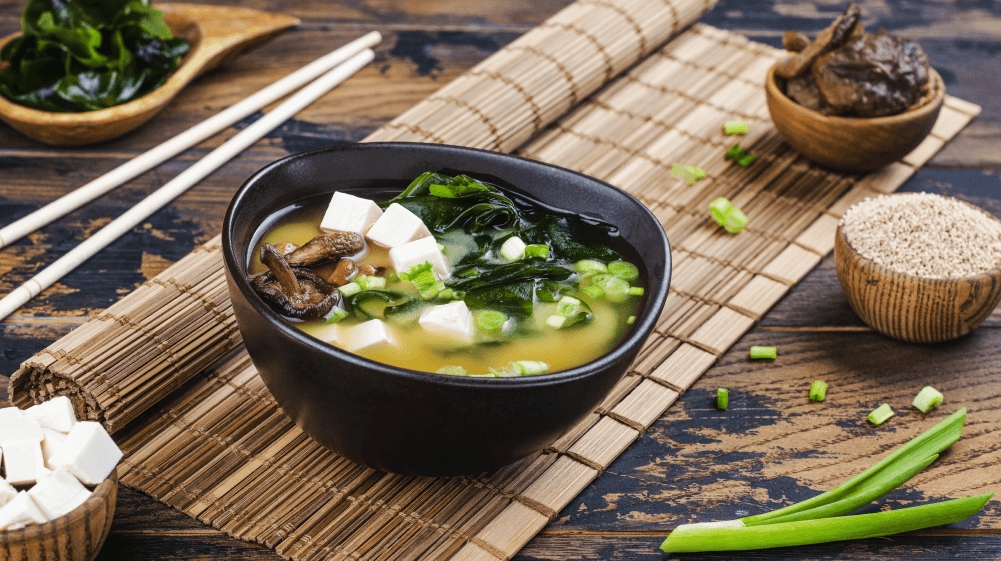
At the beginning of 1900, Kikunae Ikeda, professor at the Imperial University of Tokyo, interested in the relationship between the chemical structure of substances and their respective smell and flavour, noticed that in some typical foods of Japanese cuisine there was a taste that was not attributable to the 4 basic tastes known at the time. This taste was present in Katsobushi broth, a tuna broth, Kombu seaweed and dried Shiitake mushrooms and Professor Ikeda identified it as a unique taste, describing it as tasty and delicious and called it Umami which in Japanese means savory .
The umami substance par excellence, first isolated by Professor Ikesa, is monosodium glutamate. Subsequently, other molecules responsible for this taste were recognized and can be classified into two categories:
- amino acids or peptides: among which we find monosodium L-glutamate, tricholomic acid and ibotenic acid
- ribonucleotides: i.e. inosine 5'-monophosphate (IMP) and guanosine-5'-monophosphate (GMP).
Umami substances, even if present below the perception threshold, have the ability to enhance the flavor due to other components present in the food and for this reason they are defined as flavor enhancers .
A peculiarity of these substances is the synergistic effect they have when used in combination with each other: in fact the joint use of monosodium glutamate and one of the two ribonucleotides in the same food causes a much greater umami effect than expected as the sum of the umami effects of the individual substances.
After its discovery, monosodium glutamate was introduced onto the US market around the 1920s but did not immediately have great success, and only around the 1970s did these flavor enhancers begin to gain a foothold both in America and Europe.
Glutamate was initially produced by hydrolysis of waste plant material with high protein content and subsequently purified by crystallization. Since the 1950s, however, we have moved on to the production of glutamate by fermentation of molasses by the microorganism Corinebacterium glutamicum, while in 1962 the production of ribonucleotides began after approval by the Food and Drugs Administration.
In recent years, interest in the umami taste has increased considerably and this is certainly because the consumption of ready-to-eat foods (rich in these flavor enhancers) has increased in society but also because awareness of the problems caused by consumption excessive salt and consequently the number of people who choose to reduce the use of this condiment by partially replacing it with flavor enhancers is growing.
What are umami foods?
Glutamate is a derivative of glutamic acid, one of the amino acids that make up proteins, both plant and animal. What has an umami effect, however, is the free glutamate and not that contained in proteins: for example, two foods considered very umami are parmesan and raw ham in which, in both cases, during maturation a partial hydrolysis of the proteins occurs with release of glutamate responsible for this taste. Other foods that have large quantities of glutamate are mackerel, sea urchins, dried tuna but also tomatoes, potatoes and kombu.
Inosine monophosphate (IMP) is produced by the decomposition of AMP (adenosine monophosphate) and we find it abundantly in sardines, anchovies and tuna while guanosine monophosphate (GMP), produced by the enzymatic decomposition of RNA, is present in high quantities in dried mushrooms and its content increases particularly with cooking!
Shiitake mushrooms are among the foods of plant origin characterized by the umami taste, come and discover our dried and granulated shiitake mushrooms and all IoBoscoVivo products that are not only good in taste but also very rich from a nutritional point of view!
Bibliography
- Stańska, K., & Krzeski, A. (2016). The umami taste: from discovery to clinical use. Otolaryngologia polska = The Polish otolaryngology , 70(4), 10–15. Available at https://doi.org/10.5604/00306657.1199991