
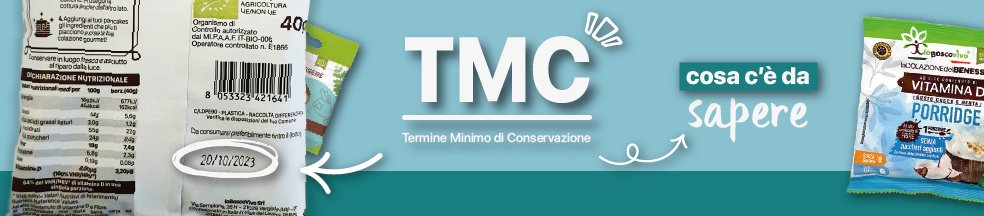
“TMC” of a food: What is it?
Share
Is it a legislative reference or is it provided at the discretion of the manufacturer? Today let's shed some light on this very delicate topic!
Premise
EC Regulation 1169/2011, which regulates the labeling of food products in Europe, prescribes the mandatory indication of shelf-life on the labels of packaged food products. This indication can be of two types, depending on the nature of the food:
- the expiry date ('use-by date'), which must be used for highly perishable foods from a microbiological point of view;
- the TMC ('best before date'), which can be used for food products that are stable from a microbiological point of view, as in the case of our IoBoscovivo products,
Who decides these dates?
Apart from some exceptions (eggs, for example), the responsibility for determining the shelf life of foods lies with the manufacturer, who must ensure that the product is safe from a health point of view throughout its established commercial life.
To do this, we rely both on bibliographic data (comparison with similar products, type of packaging used), and on specific tests (both in accelerated and fixed-term form), always carried out keeping in mind the concept of "risk analysis" and foreseeing , therefore, if necessary, the entrusting of specific analyzes to accredited laboratories.
Naturally, not only safety is evaluated, but also the organoleptic qualities of foods and other aspects of legal relevance, such as:
- any loss of weight or volume;
- possible risks linked to migrations of substances from the packaging;
- maintenance of minimum values of nutrients, micronutrients and substances subject to nutrition claims and/or health claims (in IoBoscovivo products for example we evaluate that the presence of vitamin D indicated is also present at the end of the shelf lifeJ).
Can the manufacturer decide to extend the shelf life initially established by re-labelling the product?
The manufacturer can also decide to re-determine the TMC of already packaged foods, applying the same criteria indicated above, where it verifies that they do not present safety risks or have changed their organoleptic properties or other important requirements.
Also in this case, the new date is determined independently by the manufacturer based on observations on previous batches, organoleptic tests, any laboratory tests, taking into account the nature of the product, the conservation methods (also in the logistics, distribution and after-sales) and consumption methods.